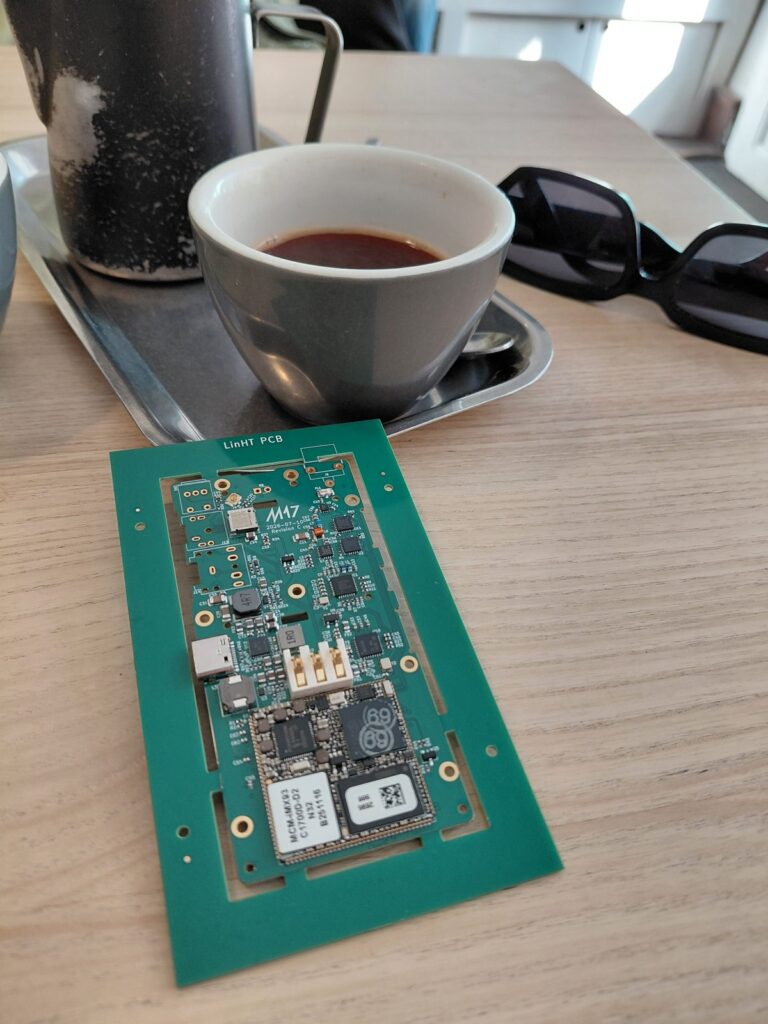
The first LinHT Rev C board is alive. We brought it up in two evenings in the middle of October, and so far Rev C does what Rev B didn’t: it boots without hardware workarounds, enters USB boot mode from the side button, plays audio, gets a GNSS fix and transmits M17.
This post summarizes what we changed in Rev C, how the bring-up went, what works, what we still have to measure, and, most importantly, what comes next. Many of you are asking when you can get a board. The short answer is: we are preparing the first production batch, and the price of the SoM decides most of the rest. The long answer is below.
If you missed the previous status, start with LinHT Rev B status: what works, what broke, and why Rev C is next. Rev C is the direct result of that list.
TL;DR
- LinHT Rev C works. M17 TX, USB-C networking, audio, microphone, GNSS, USB boot from the side button and power management are verified.
- Most of the original C62 board stays untouched. Only the display and, for now, the SMA connector come from the donor.
- Seven Rev C boards exist or will exist next week, using all the SoMs we had.
- Next is a production batch of at least 50 kits. We are waiting for the SoM quote from CompuLab.
- Ballpark: EUR 250–400 per kit, tax included, shipping not included, to be refined within a few weeks. The donor C62 (around USD 65) is not included.
- LinHT will be sold as a kit for radio amateurs. Assembly and operation according to the rules of your country are your responsibility.
- How we will sell it (crowdfunding, Lectronz threshold pre-order, or Foundation-funded) will be decided by the M17 Foundation. Tell us what you prefer.
What changed in Rev C
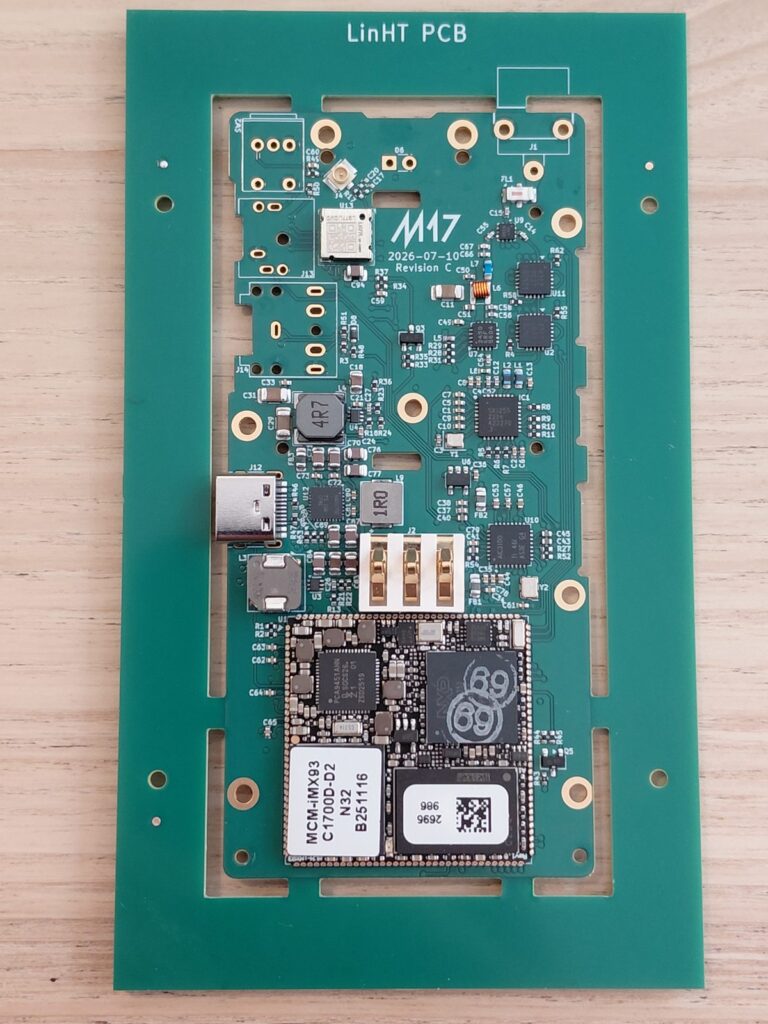
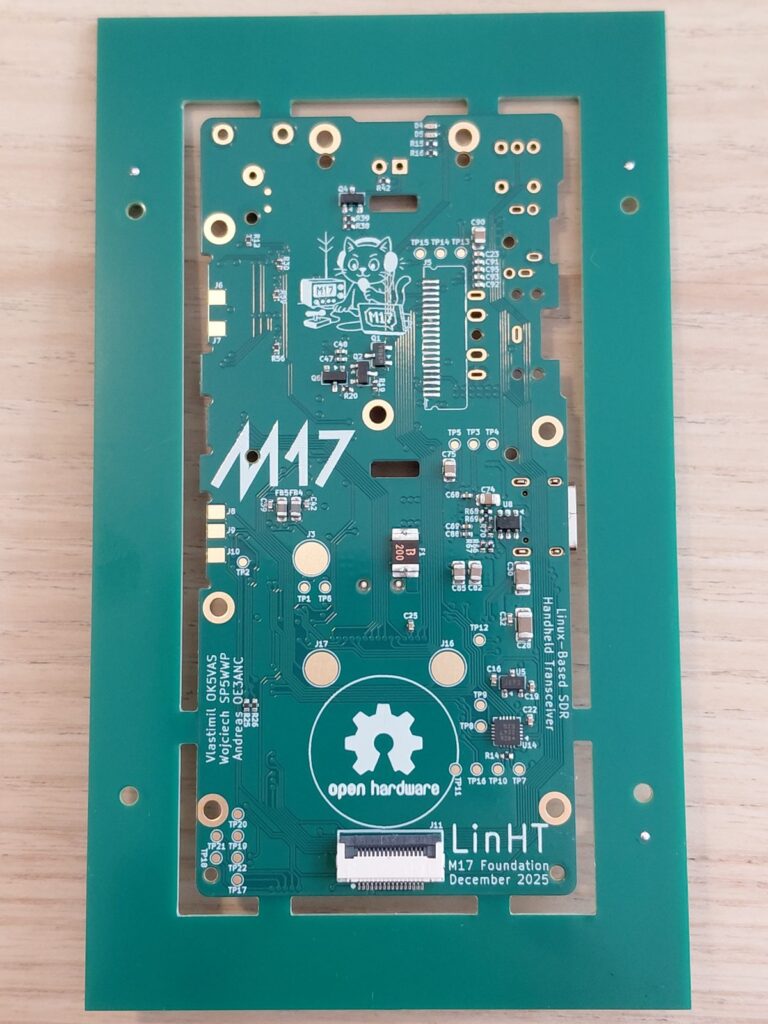
Rev C is not a redesign. It is the Rev B board with the problems from the Rev B testing fixed. The main changes are:
- Side button and USB boot. The voltage domains are now isolated. The ATtiny826 reads the physical button and drives the 1.8 V SoM boot input as open-drain. No more random USB boot.
- Audio codec reset. The TLV320AIC3100 reset line now goes to a SoM GPIO, so Linux can reset the codec properly. No more wire hack.
- Audio clock. The 12.288 MHz oscillator was replaced with a 12 MHz one, which the codec driver supports without board-specific patches in the Linux kernel.
- GNSS antenna. The on-board chip antenna that ended up detuned by the aluminium chassis is gone. Rev C has a U.FL connector for an external antenna instead.
- BOM and assembly. Obsolete inductors were replaced, small ground-connected pads got thermal relief to reduce tombstoning, and all DRC errors and warnings were resolved.
The full list is in the hardware changelog.
Bring-up in two evenings
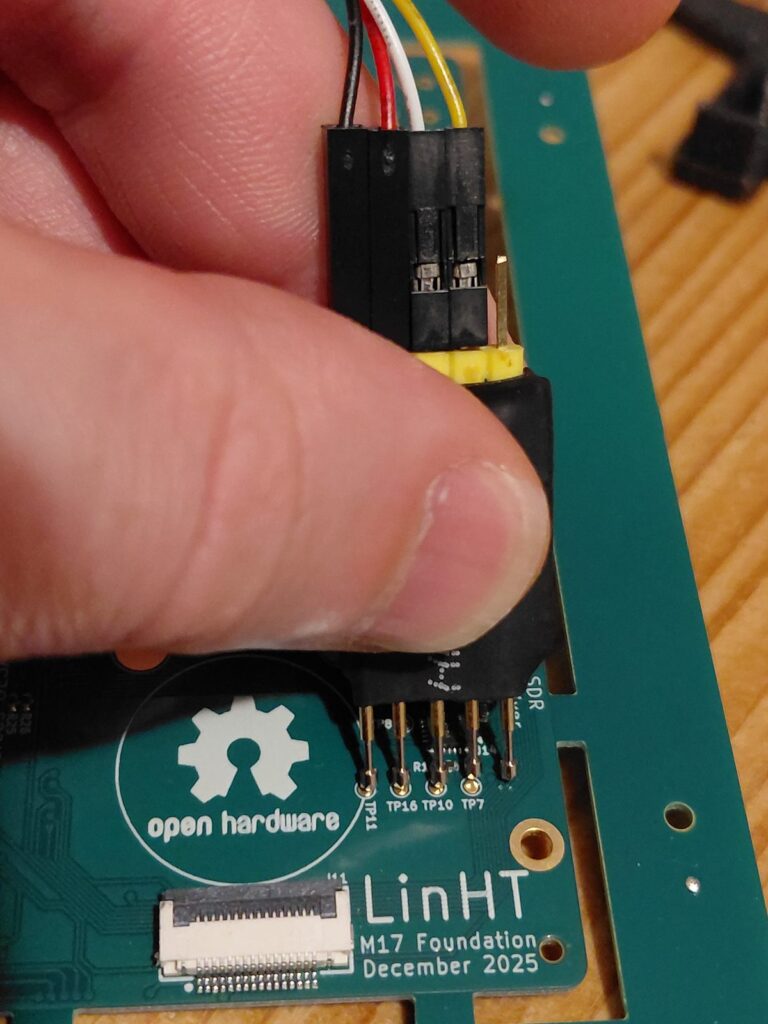
The first assembled Rev C boards arrived on October 16. Bring-up followed the same order as with Rev B, just with far fewer surprises:
- check the voltages and currents in every part of the board,
- flash the ATtiny826 power-management controller, then debug and tune its firmware until the power sequencing and shutdown worked,
- first boot of a blank SoM, entering USB boot mode with the side button,
- flash the eMMC with NXP
uuuand boot Linux.
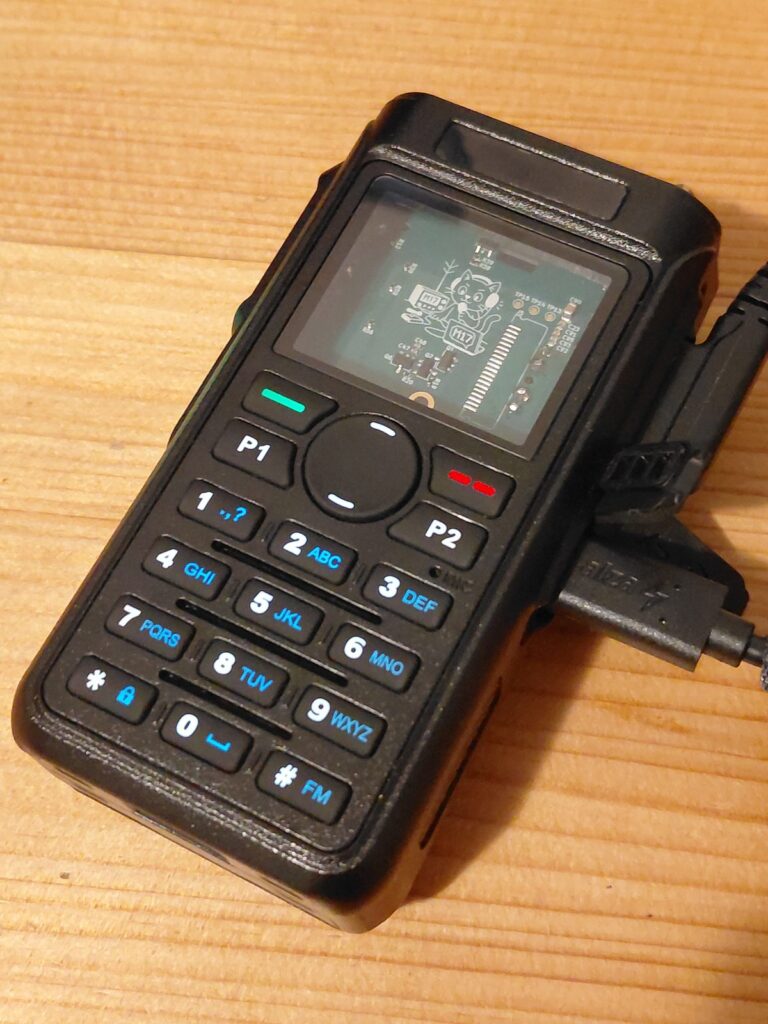
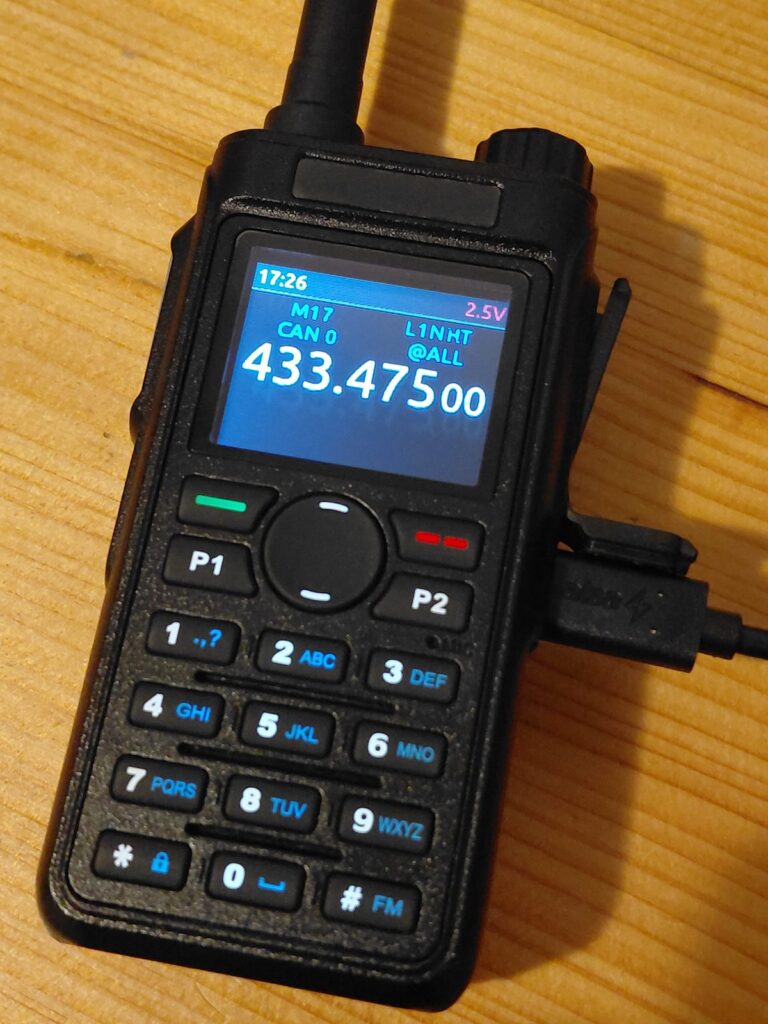
On October 18 the board went into the Retevis C62 chassis. I soldered in the display, Linux booted, and the M17 UI came up. The same evening I made the first M17 transmission from Rev C.
What works on Rev C
M17 transmit
The RF chain works. Here is LinHT Rev C transmitting M17, received on my modified TYT MD-UV390 running OpenRTX:
We already know from Rev B that the GRF5604 PA can deliver several watts. On Rev C I only did transmit tests so far; proper power measurements are still on the list (see below).
Network, audio codec and speaker
This one is my favourite test. I connected LinHT to my PC over USB-C, shared the PC’s internet connection to it, and wrote a small script that plays the Czech Radio Radiožurnál stream through the internal speaker via ALSA.
It is a silly demo, but it verifies a long chain at once: USB-C, the USB Ethernet gadget and networking, the TLV320AIC3100 codec with its new reset and clock, the device tree, ALSA and the speaker. The microphone works too.
GNSS
Rev C has a U.FL connector for the Quectel LG77L GNSS module instead of the chip antenna. For the first test I connected a short pigtail, made an improvised passive antenna for the GPS L1 frequency, and tried it from the balcony of my flat. It got a 3D fix almost immediately. This is the output of my test script (with my exact position removed):
LinHT LG77L GNSS
UART: receiving  last valid NMEA: 0.1 s ago
Fix: 3D  GGA quality: 1
Position: 49.2******, 16.6****** deg  altitude MSL: 230.4 m
Speed: 0.0 km/h  course: 5.7 deg
Receiver UTC: 201026 161112.000 UTC (ddmmyy hhmmss.sss)
Satellites: used 8, in view 16, with C/N0 11
DOP (geometry, not metres): H 2.80  P 2.97  V 0.97
Antenna message: ANTSTATUS=OPEN [detection NOT wired on Rev C]
Rev C: NO DC antenna bias. An active antenna needs external power via a suitable bias tee.
NMEA: valid 360, bad checksum 0, malformed 0
Signal: per-satellite C/N0 in dB-Hz (not RSSI/dBm). # = about 2 dB-Hz.
 SAT     SIG  ELEV   AZIM   C/N0   SIGNAL
 GL81      1    36     45   39.0   ###################
 GL71      1    34    285   35.0   #################
 GP19      1    26     49   35.0   #################
 GL73      1    40    299   34.0   #################
 GP32      1    33    294   32.0   ################
 GL80      1    66     45   29.0   ##############
 GP12      1    --     --   26.0   #############
 GP25      1    52    275   25.0   ############
 GP13      1    82      4   20.0   ##########
 GL83      1    13    162   19.0   #########
 GP24      1    45    151   19.0   #########
 GL70      1    13    223     --
 GL72      1    22    330     --
 GL75      1    --     --     --
 GL82      1    46    111     --
 GP37      1    33    173     --
Eight satellites used, sixteen in view, and C/N0 up to 39 dB-Hz on a piece of wire. Compare that with Rev B, where the chip antenna never got a fix. Note that Rev C provides no DC bias on the antenna connector. It is meant for passive antennas; an active antenna needs a bias tee.
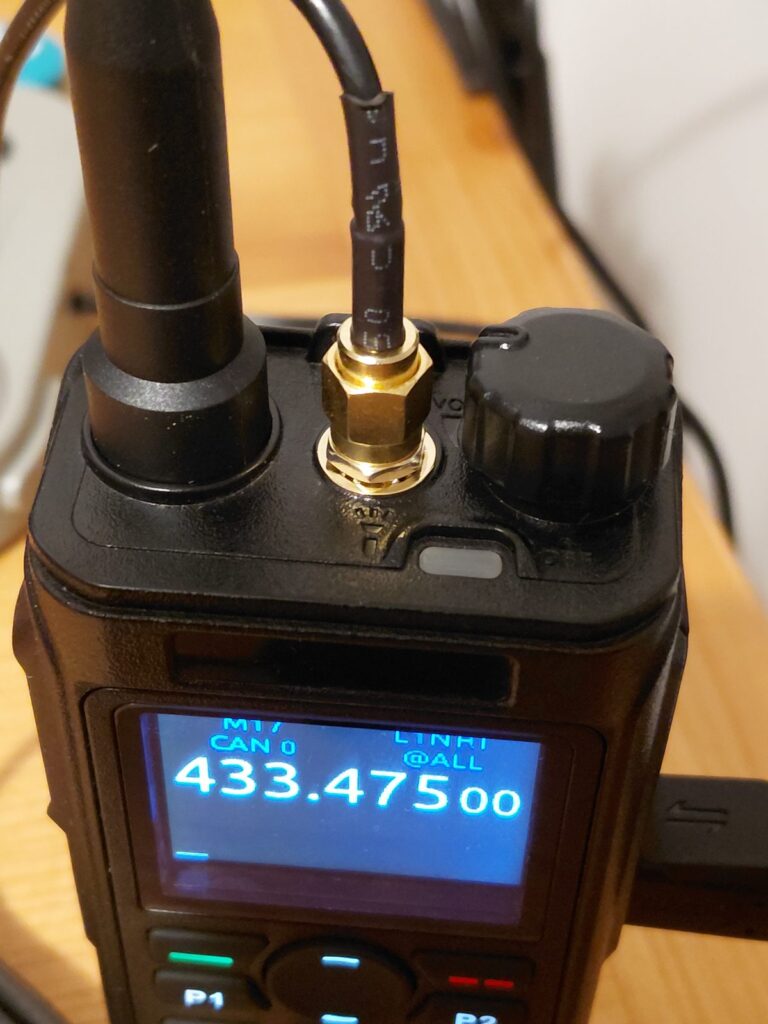
The final solution is still open. One option is a small antenna PCB that goes where the original flashlight LED is. The other is to leave it to the users. I also tried a U.FL to SMA pigtail: an SMA connector fits into the LED hole, so you can connect any external antenna without drilling the chassis.
Power management and the always-on domain
- USB-C charging and power management work.
- The ATtiny826 is always on and handles power-up, power-down and the rail sequencing.
- The SoM RTC and the GNSS module are on the always-on supply as well.
- USB boot mode: hold the side button and switch the radio on.
Less soldering on the donor radio
LinHT is a replacement mainboard for the Retevis C62. With Rev B you had to move many parts from the original C62 board. With Rev C most of the original board can stay untouched.
We designed a small side-button PCB that is soldered to the side of the LinHT board. Metal snap domes go on top of it and an adhesive film covers them, the same solution as in the original C62. I tested it and it works. You can either desolder the side-button PCB from your donor C62, or build ours from the kit.
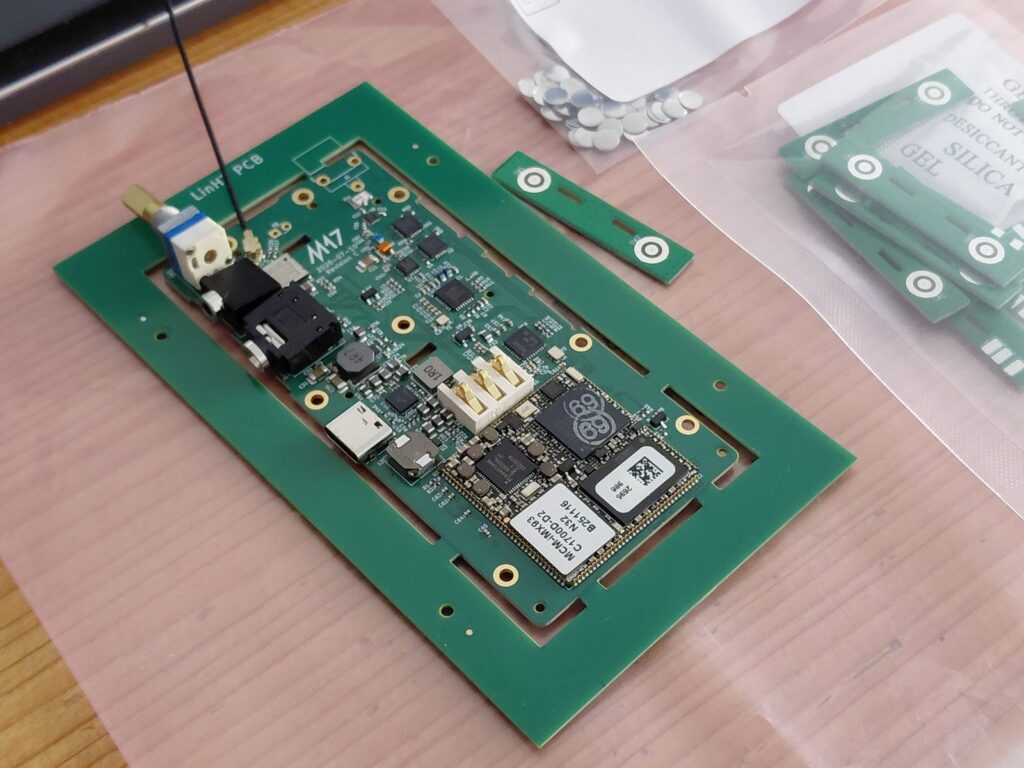
We also have both audio jacks (2.5 mm and 3.5 mm) and the on/off switch with volume control. The only things you have to take from the donor C62 board are:
- the display, which is soldered to the LinHT board,
- the SMA connector, for now. We have a candidate part but have not ordered it yet. If we can buy it, it will be in the kit.
What we still need to test
Rev C works, but it is still a prototype and still experimental hardware. The open items:
- RF measurements. We know the PA and the RF path work from Rev B, and Rev C transmits. We have not measured the exact output power, harmonics and efficiency on Rev C yet.
- Thermals. We do not know yet how long LinHT can transmit continuously at full power before the PA gets too hot. Silicone thermal pads between the PA, the SoM and the aluminium chassis are part of the plan.
- Software. Andreas OE3ANC is testing a new Yocto Linux version for Rev C.
- SMA connector. Find and buy a part that fits the C62 chassis.
- GNSS antenna. Decide between a small antenna PCB and leaving it to the users.
How many boards exist
We built and brought up three Rev C boards locally in the Czech Republic, and we will assemble four more next week. That uses up all the CompuLab MCM-iMX93 SoMs (MCM-iMX93-C1700D-D2-N32) we bought back in December 2025, at that time for about USD 75 each plus shipping, duties and taxes. These seven boards go to development and testing.
To make more, we need a proper production batch.
What comes next: the first batch
LinHT is a dense, six-layer board assembled on both sides. Making a few boards is expensive: PCB setup, stencils, pick-and-place programming and buying parts in small quantities cost almost the same for 5 boards as for 50. The price per board only starts to make sense with a larger run. That is why the first batch should be at least 50 kits. Below that, it is simply too expensive to make.
The biggest unknown is the SoM. Prices have most likely gone up since December 2025, and this week we asked CompuLab for a new quote. Everything else, components, PCBs and assembly in the Czech Republic, we can calculate quite precisely. As soon as we have the SoM price, we will calculate the final price and start preparing the production.
What will be in the kit
- fully assembled LinHT Rev C board, delivered in the production panel,
- through-hole parts to solder: 2.5 mm and 3.5 mm jacks, on/off switch with volume control, and the SMA connector if we can source it,
- side-button PCB with snap domes and adhesive film,
- silicone thermal pads for the PA and the SoM, so they touch the aluminium chassis.
What you need to bring
- a Retevis C62 as the donor radio: chassis, display, keyboard, battery, speaker, antenna and the other mechanical parts,
- a passive GNSS antenna with a U.FL connector, if you want GNSS,
- a good soldering iron and flux. Soldering the display is the hardest step, but it is very doable,
- some patience for a small mechanical modification of the aluminium part of the C62 chassis.
LinHT will be sold as a kit for radio amateurs. It is experimental development hardware, not a finished consumer product. Assembling it, bringing it up and operating it according to the rules of your country is your responsibility.
Ballpark price
We do not have a price yet, but we know you want a number. The SoM carries 2 GB of RAM and 32 GB of eMMC, and memory prices have multiplied since we bought the SoMs in December 2025. So we take the December 2025 price as the optimistic case and a much more expensive SoM as the pessimistic case. Our current rough estimate is EUR 250–400 per kit, taxes included, shipping not included. On top of that you need the donor Retevis C62, which costs around USD 65 on AliExpress.
Treat this as a ballpark, not a quote. This is a small first batch and we are learning how to do it. We expect to make the estimate much more precise within a few weeks, once we have the SoM quote. The SoM price is the biggest unknown: every USD 10 on the SoM moves the kit price by roughly EUR 10. We would rather give you a higher number now and announce a lower one later than the opposite.
This is how the costs break down per kit for a batch of 50. The table does not include taxes, which depend on the final sales setup:
| Item | Optimistic | Pessimistic |
|---|---|---|
| CompuLab SoM incl. shipping (2 GB RAM, 32 GB eMMC) | EUR 68 | EUR 134 |
| Other electronic components | EUR 55 | EUR 75 |
| PCBs, stencils, shipping | EUR 10 | EUR 15 |
| SMT assembly in the Czech Republic | EUR 8 | EUR 24 |
| Kit parts (jacks, switch, side-button PCB, domes, thermal pads, SMA) and packaging | EUR 9 | EUR 14 |
| Reserve for boards that fail testing (5 % / 10 %) | EUR 8 | EUR 26 |
| Sales platform and payment fees | EUR 14 | EUR 25 |
| Total | EUR 172 | EUR 313 |
How we will sell it
Thank you for all the ideas on Discord. These are the options we are considering:
- Crowdfunding on Kickstarter, Crowd Supply or a similar platform. It reaches many people, but it needs a lot of campaign work, and some platforms require CE and FCC certification first.
- Threshold pre-order through my (Vlastimil OK5VAS) Lectronz store, where I already sell my LoRa and Meshtastic/MeshCore projects and ship to most of the EU, Switzerland and the USA. You pre-order with your card, but you are not charged until the campaign ends. If at least 50 kits are pre-ordered, all pre-orders turn into orders and we start production. If not, the campaign is cancelled and nobody pays anything. This is not crowdfunding: we are not raising money to develop LinHT. The design is done and open, and the pre-order only pays for a production batch.
The final decision is up to Wojciech SP5WWP and the M17 Foundation, and it will depend on the final price per kit. We want to choose the way that is most convenient for you. If you have an opinion, tell us on Discord. We will take it into account.
We expect to have the SoM quote and a more precise price within a few weeks. We will post an update here and on Discord.
How you can help right now
Some of you already bought a C62 and are ready to test. Thank you! Keep it. You will need it as soon as boards are available. Until then:
- join the #linht-dev channel on the M17 Discord and tell us which way of ordering you prefer,
- look at the hardware and the software. There is a lot of work on Linux, the UI and applications that does not need a board,
- tell other people about LinHT. Real interest from the community is what makes the first 50 possible.
Thank you
LinHT is still a small-team project. Wojciech SP5WWP leads the M17 side of the project and reviews the hardware, Andreas OE3ANC does Yocto, Linux integration, drivers and much of the testing, and I, Vlastimil OK5VAS, do the PCB design, manufacturing and hardware bring-up. Thanks also to everyone on Discord who shared ideas and experience about crowdfunding, pre-orders and regulations, and to all of you who keep asking when you can get one. That is a good kind of pressure.
Links: project page linux-radio.eu, hardware repository M17-Project/LinHT-hw, and the M17 Discord, channel #linht-dev.
Stay tuned.
Leave a Reply